Butter, Patience, and a Whole Lot of Folding: The Real Story Behind Laminated Pastries
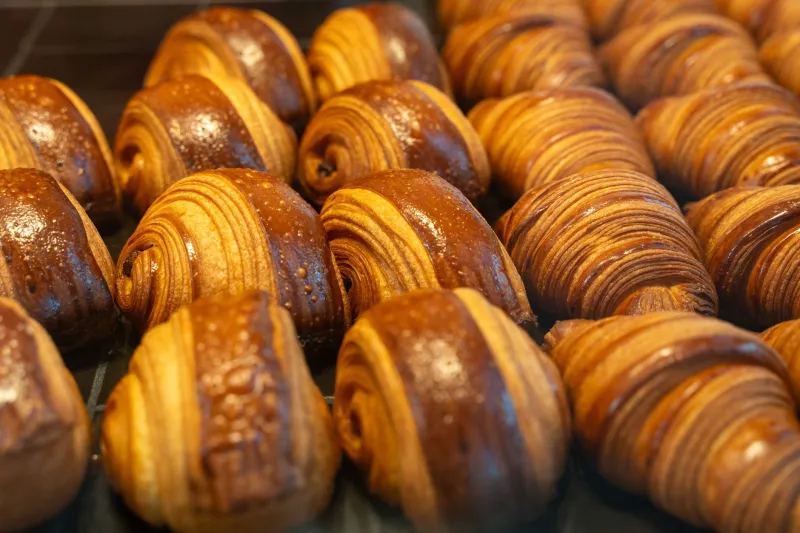
There's a moment every Saturday morning at Sachdev Bakery & Cake House when the first tray of croissants comes out of the oven. The kitchen smells like warm butter and toasted wheat, and the pastries sit there — golden, blistered, almost impossibly flaky — looking like they just happened. Like they were easy.
They were not easy.
Laminated doughs are arguably the most technically demanding category of baked goods a bakery can take on. More than custom cakes, more than finicky choux, more than sourdough with its moody wild yeast. And yet croissants and Danishes are so familiar, so tied to weekend coffee runs and hotel breakfast buffets, that most people assume they're a commodity — something churned out by a machine somewhere and dropped into a warmer.
Let's talk about what actually goes into them.
What "Laminated" Even Means
The term comes from the process of layering — specifically, folding a block of cold butter into a yeasted dough over and over again until you've created hundreds of distinct, paper-thin alternating sheets of fat and dough. When that layered structure hits oven heat, the water in the butter turns to steam. That steam pushes the layers apart. The result is the honeycomb interior and shatteringly crisp exterior that defines a great croissant.
The history of this technique stretches back centuries. Viennese bakers are often credited with popularizing laminated pastries across Europe in the 1800s — which is why you'll still hear croissants described as Viennoiserie in French baking tradition. Danish pastry, despite its name, was actually heavily influenced by Austrian bakers who migrated to Denmark in the mid-19th century. The technique traveled, evolved, and eventually landed on American breakfast tables, where it's been — largely — industrialized beyond recognition.
The croissant you get from a drive-through is not the croissant we're talking about here.
The Three Enemies: Heat, Haste, and Humidity
Here's why laminated doughs humble even experienced bakers: the entire process depends on keeping butter and dough at exactly the right temperatures simultaneously, for hours, sometimes across two days.
The butter needs to stay cold enough that it doesn't melt into the dough — which would collapse all those beautiful layers into a greasy, dense mess. But it also can't be so cold that it shatters and breaks through the dough when you roll it. That sweet spot is roughly 60°F, which in a home kitchen on a warm afternoon is almost impossible to maintain without a commercial walk-in cooler.
This is one of the biggest reasons home bakers struggle with croissants. The dough goes into the fridge between folds, sure, but if your kitchen is running warm, even a few extra minutes on the counter can start softening that butter layer. You won't see the damage until the pastries come out of the oven flat and dense instead of billowy and layered.
Humidity is the other silent saboteur. Excess moisture in the air makes the dough sticky and difficult to roll cleanly. Dry conditions can cause cracking. Professional bakeries control their environments carefully — a luxury most home kitchens simply don't have.
The Fold Count Matters More Than You Think
Traditional croissant dough goes through what bakers call a series of "turns" — each turn involves folding the dough over itself in a specific pattern (typically a letter fold or a book fold) before chilling and repeating. A classic croissant recipe calls for anywhere from 27 to 81 layers depending on the number of turns.
Too few folds and you lose definition. Too many and the layers merge together, losing that open, airy crumb. The specific sequence of folds, the resting time between each one, and the pressure applied while rolling all affect the final texture in ways that are genuinely hard to describe — you have to feel it, over dozens of batches, before it becomes intuitive.
At Sachdev, our laminated pastry process spans two days minimum. The dough is mixed and rested overnight. The butter block is prepared separately, chilled, and worked to the right pliability before it ever touches the dough. Then the folding begins — methodical, unhurried, with rest periods that aren't shortcuts but necessities.
Where Industrial Production Goes Wrong
Commercial bakery operations that produce laminated pastries at scale face a fundamental tension: the technique is inherently slow, and slow doesn't scale cheaply. The solution most large producers have landed on involves margarine or shortening instead of real butter (more forgiving temperature-wise, cheaper to source), mechanical sheeting machines that can move fast but apply uneven pressure, and accelerated proofing environments that rush the yeast.
The result is something that looks like a croissant. It has the shape, the color, sometimes even a reasonable approximation of the flake. But bite into it and you'll notice the interior is bready and uniform rather than open and honeycomb-like. The flavor is flat. The crust bends instead of shatters.
This isn't a knock on every large operation — some do genuinely excellent work. But it explains why an artisanal croissant from a bakery that actually cares about the process tastes so dramatically different from what most Americans encounter on a daily basis.
A Few Things Home Bakers Can Try Right Now
If you want to attempt laminated pastries at home — and we genuinely encourage you to try — here are a few things that will actually move the needle:
Use European-style butter. American butter typically runs around 80% fat. European-style butters (Kerrygold is widely available at most US grocery stores) clock in at 82-84%. That extra fat matters for flavor and workability.
Work in the coolest part of your kitchen. If that means baking in the early morning before your house warms up, do it. Winter is genuinely the best season for laminated dough projects.
Don't rush the proof. After shaping your croissants, let them proof at room temperature until they're visibly jiggly and have grown noticeably — this can take three to four hours. Rushing this step is one of the most common reasons home croissants bake up dense.
Egg wash twice. A thin coat before proofing and another right before the oven gives you that deep mahogany color that makes a croissant look like it belongs in a Parisian window.
Why We Still Make Them By Hand
Honestly? Because no machine has figured out how to care about what it's making.
Laminated pastries reward attention in a way that's almost philosophical. Every fold is a decision. Every resting period is a form of respect for the ingredients. When we pull a tray of croissants out at Sachdev and they've come out right — properly layered, deeply golden, with that unmistakable shatter when you break one open — it never stops feeling like an accomplishment.
These aren't just breakfast items. They're a reminder that some things are worth doing slowly, carefully, and by hand. And that's exactly the kind of baking we're committed to every single day.