Why Your Dream Cake Didn't Survive the Ride — And What We Do So It Always Does
Let's be honest about something most bakeries don't like to talk about: cakes fall. Tiers shift. Flowers droop. Fondant panels crack right down the middle on a bumpy stretch of road. It happens. And when it does, it happens at the worst possible moment — usually an hour before a wedding reception or a milestone birthday party where a hundred people are about to walk through the door.
We've heard the horror stories. We've even lived a few of our own. And rather than pretend custom cake delivery is a smooth, effortless experience every single time, we'd rather tell you the truth — because understanding what can go wrong is exactly how we've gotten so good at making sure it doesn't.
The Real Reason Multi-Tiered Cakes Are So Tricky
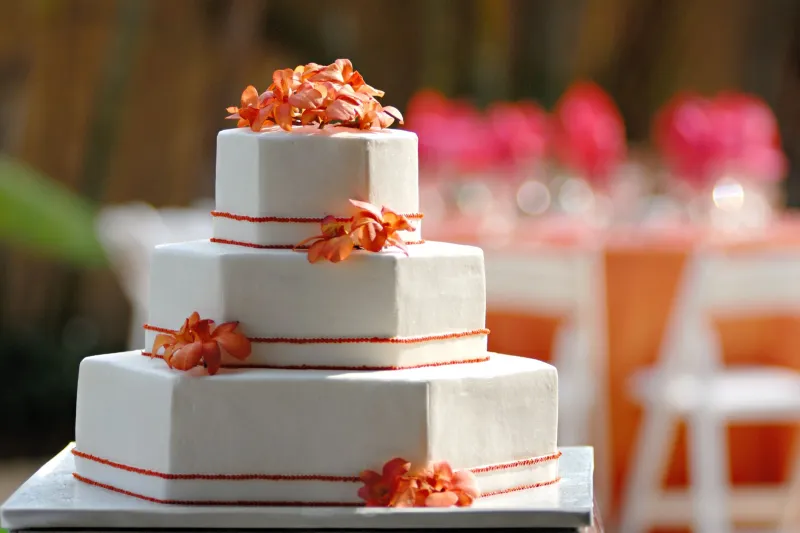
Here's something most people don't think about when they're scrolling through gorgeous tiered cake photos: what you're looking at is essentially edible engineering. A three-tier wedding cake can weigh anywhere from 15 to 30 pounds. That weight is stacked vertically, supported by internal dowels, and covered in materials — buttercream, fondant, fresh flowers, sugar sculptures — that each respond differently to temperature, humidity, and motion.
When a car brakes hard or takes a sharp turn, that cake experiences real physical forces. Inertia pulls at the upper tiers. Buttercream that was perfectly chilled in our cooler starts softening the moment it hits a warm car interior. Sugar flowers, which are beautiful but brittle, can snap from even a small vibration. A cake that looks structurally perfect on the decorating table can become a very expensive, very sad situation 45 minutes into a highway drive.
None of this is a flaw in the design. It's just physics — and physics doesn't care about your timeline.
The Moments That Taught Us the Most
A few years back, we delivered a four-tier cake for a summer garden party. The design was stunning — hand-painted watercolor tiers with cascading sugar peonies. We loaded it carefully, drove cautiously, and felt pretty confident. What we didn't fully account for was the 94-degree heat that had built up in the venue's outdoor tent. By the time we set it down, the bottom tier was starting to lean, and the fondant was developing what we can only describe as a slow-motion slide.
We caught it in time. Barely. But that afternoon changed how we think about summer deliveries entirely.
Another time, a gorgeous two-tier cake with a fresh floral crown arrived with one side of the crown completely flattened — we'd underestimated how much the flowers would shift when the box tilted slightly on an uneven driveway. The cake tasted incredible. It looked like it had a rough morning.
These aren't stories we tell to embarrass ourselves. We tell them because they're exactly why our current process is as careful as it is.
What We Actually Do Differently
After enough hard-earned lessons, we built a delivery system that treats every custom cake like the irreplaceable object it is. Here's what that looks like in practice.
Internal structure comes first. Every tiered cake we build gets a food-safe dowel system inside each tier — wooden or plastic rods that bear the weight of whatever sits above them. For taller or heavier designs, we use a central support rod that runs through the entire cake like a spine. This isn't optional, and it's not something we skip to save time.
Temperature management is non-negotiable. Our delivery vehicle is temperature-controlled, and cakes go out chilled — cold enough to hold their shape but not so cold that condensation becomes an issue when they hit room-temperature air. In summer months, we're even more aggressive about this. Buttercream in particular needs to stay cool; it's the difference between a cake that holds its edges and one that slowly melts into itself.
The box matters as much as the cake. We use custom-fitted cake boards and non-slip matting inside our transport boxes so the cake doesn't slide. The boxes themselves are sized specifically for each order — not a one-size-fits-all situation where a cake is rattling around with six inches of empty space on every side.
We don't rush. This sounds simple, but it's genuinely part of our philosophy. We build in extra time before every delivery so we're never taking corners fast or braking hard because we're running late. The cake sets the pace, not the schedule.
On-site assembly when it makes sense. For very tall or complex designs, we'll sometimes transport the tiers separately and assemble the cake at the venue. It takes longer and requires more coordination, but the result is a structurally sound cake that was never subjected to the full stress of road travel as a single stacked unit.
What You Can Do to Help
Delivery is a partnership. Here are a few things that genuinely make a difference on your end.
Have a flat, stable surface ready when we arrive — not a folding table that wobbles, not a cloth-covered surface that can shift. A solid table at a comfortable height is ideal. If your venue has stairs or an uneven path from the parking area, let us know in advance so we can plan accordingly.
Keep the display area away from direct sunlight and heat sources. We've seen beautiful cakes positioned right next to a window in a sun-drenched reception hall, and by the time the cake-cutting moment arrived, the frosting had developed a definite lean toward the light. A few feet makes all the difference.
And if you're picking up a cake yourself rather than using our delivery service — which we're totally supportive of — please, please keep it flat in your vehicle. Not on a seat. Not on your lap. Flat, in the trunk or cargo area, on a non-slip surface, with the air conditioning on.
The Part Nobody Talks About
There's something kind of quietly remarkable about what a custom celebration cake represents. Someone is trusting us with a moment that can't be replicated — a wedding, a retirement party, a child's first birthday. The stakes are genuinely high, and we feel that weight every single time we load a cake into the delivery vehicle.
The engineering and logistics are just how we honor that trust. Every dowel we place, every degree we monitor, every careful turn we take — it's all in service of making sure the thing you imagined actually shows up looking the way it should.
Cakes are delicious. They're also, in the right hands, a little bit of a miracle. We're just trying to make sure yours arrives that way.