From Our Counter to Your Table: The Surprisingly Complex Journey Inside a Cake Box
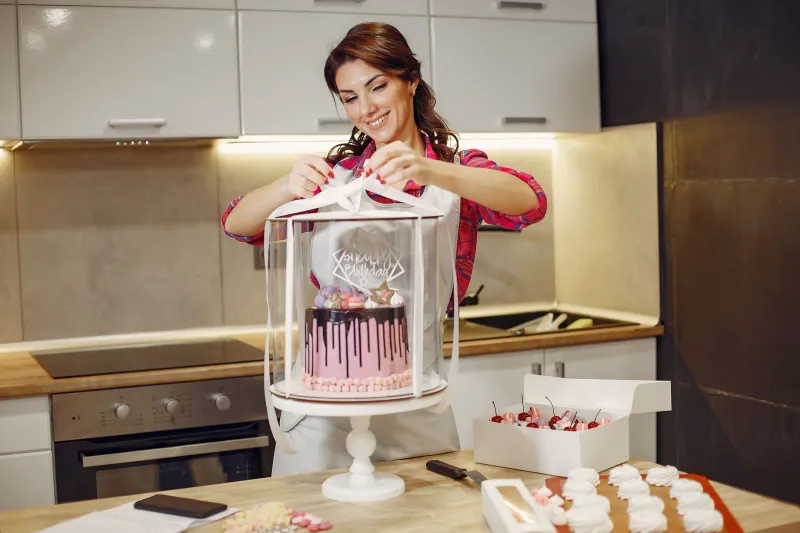
There's a moment every baker quietly dreads — and it has nothing to do with the oven.
It's the moment a finished cake leaves the shop. The hours of mixing, leveling, filling, crumb-coating, and decorating are done. The result is sitting on the counter looking exactly the way it should. And then it has to travel.
Most customers think about the cake. Fewer think about the box. But here at Sachdev Bakery & Cake House, we'd argue the box deserves just as much attention — because a packaging decision made in thirty seconds can undo six hours of careful work in about the same amount of time it takes to hit one bad pothole.
So let's talk about what actually happens between our counter and yours.
Why Cake Packaging Is a Legitimate Science
It sounds dramatic to call cardboard and tape a science, but the physics involved are genuinely unforgiving. A decorated cake is essentially a soft, moisture-rich structure balanced on a board, coated in material that responds to heat, humidity, and pressure. The moment it enters a box, it enters a microclimate — one that you either manage deliberately or leave to chance.
Ventilation is the first variable. A completely sealed box traps warm air rising off the cake, which creates condensation on the interior walls. That moisture has to go somewhere, and more often than not, it migrates to the frosting. Buttercream gets tacky. Fondant can develop a sweaty sheen. Delicate piping softens. Tiny vent perforations — something most customers never notice — are specifically there to let that warm air escape without compromising the structural walls of the box.
At the same time, too much airflow dries out exposed cake surfaces, particularly cut edges or cakes with minimal frosting coverage. Getting that balance right depends on the type of cake, the frosting used, and even the season.
The Box Isn't One-Size-Fits-All
This surprises a lot of people. When you order a custom cake from us, the box it goes home in is chosen specifically for that cake — not just in terms of size, but depth, wall thickness, and whether it needs a window panel or a solid lid.
Window boxes look gorgeous and photograph beautifully. They're also made from thinner material and offer less structural rigidity. For a simple birthday cake with sturdy buttercream, that's fine. For a tall layered cake with delicate sugar flowers on the sides? We'll go with a solid box every time, even if it means the reveal happens at home rather than at the counter.
Depth matters more than most people realize. A box that's too shallow forces a lid to rest on or near the top decoration, which is a disaster waiting to happen. We size our boxes so there's meaningful clearance above the tallest point of the cake — not just barely enough room, but actual breathing space that accounts for any slight settling during transport.
Temperature Is the Wildcard Nobody Talks About
Here in the US, we deal with real seasonal extremes, and both ends of the thermometer cause problems for cakes in transit.
Summer is the obvious one. A buttercream cake sitting in a hot car — even for twenty minutes — will start to soften at the surface. The frosting doesn't melt so much as it loses its structure, becoming glossy and prone to smearing against the box wall. We always remind customers to crank the AC before pickup, keep the cake flat on a level surface (never held in a lap or tilted on a seat), and refrigerate it promptly upon arrival if it's not being served immediately.
Winter brings its own headaches. Cold air makes fondant brittle and can cause condensation to form on a refrigerated cake the moment it enters a warm room — the same way a cold can of soda fogs up on a humid day. We give specific thawing guidance for colder months so the cake comes to room temperature gradually rather than shocking the frosting with a sudden change.
For orders that require longer transport or summer delivery windows, we include cold packs positioned carefully around — never under — the cake board, with insulating layers that prevent direct contact with the box surface.
The Board Underneath Matters as Much as the Box Around It
One element of cake packaging that rarely gets discussed is the cake drum or board that sits beneath the cake inside the box. This isn't decorative. It's structural.
A properly sized board — one that extends slightly beyond the cake's edge — gives the cake a stable foundation and makes it possible to lift and move the cake without touching it directly. Boards that are too small allow the cake to shift during transport. Boards that are too large can cause the cake to slide within the box if the fit isn't snug.
For multi-tiered orders, we use thicker drums at the base — sometimes double-stacked — to ensure the whole structure has a rigid, level foundation. Even a slight tilt in the base board gets amplified as you go up through the tiers, which is why we're particular about this in a way that might seem excessive until you've seen what happens when it's ignored.
What Happens When You Get Home
Opening the box is genuinely one of our favorite parts of the process — for you, anyway. We think about that moment when we're packaging. The way the cake is centered, the way any finishing touches are positioned, the way the board sits cleanly in the box so lifting it out feels effortless.
A few things we always tell customers: open the box on the surface where the cake will be displayed, not in the air. Lift from underneath the board, not by gripping the box sides. If the cake has been refrigerated, let it sit at room temperature for at least 30 to 45 minutes before serving — cold butter mutes flavor, and a cake tastes dramatically better when it has a chance to open up a little.
And if anything has shifted in transit — a flower that's moved, a small smudge on the side — reach out. We include a small amount of extra frosting with many orders for exactly this reason.
The Part That's Hard to Explain
All of this — the vent holes, the board sizing, the clearance measurements, the cold pack placement — adds up to something that's genuinely hard to see as a customer. It's invisible work. The whole point of good packaging is that you never notice it because nothing went wrong.
But this is the part of our craft that we think about constantly. Every cake that leaves Sachdev Bakery & Cake House has been considered from multiple angles: how it's built, how it's frosted, and yes — how it's going to travel. Because a beautiful cake that arrives looking like it survived an adventure isn't beautiful anymore.
We're not just baking cakes. We're handing you something that matters — a birthday, an anniversary, a graduation, a wedding. The box is the last thing we control before it becomes entirely yours. We take that seriously.